Horizons: Regional Conflicts Have Global Implications
As geopolitical tensions flare in the Strait of Hormuz and congestion worsens at the Panama Canal and Malacca Strait, John Donne’s famous words from 1624 come sharply into focus: “Never send to know for whom the bell tolls; it tolls for thee.” In today’s tightly linked global supply chain, no chokepoint is an island.
A disruption half a world away sends immediate ripples through America’s energy exports, fertilizer imports, jet-fuel logistics and agricultural markets — with very real consequences for the inland waterways and every shipper and port that depends on them.
The bell that tolls in distant straits is already tolling here at home.
U.S. Trade Implications
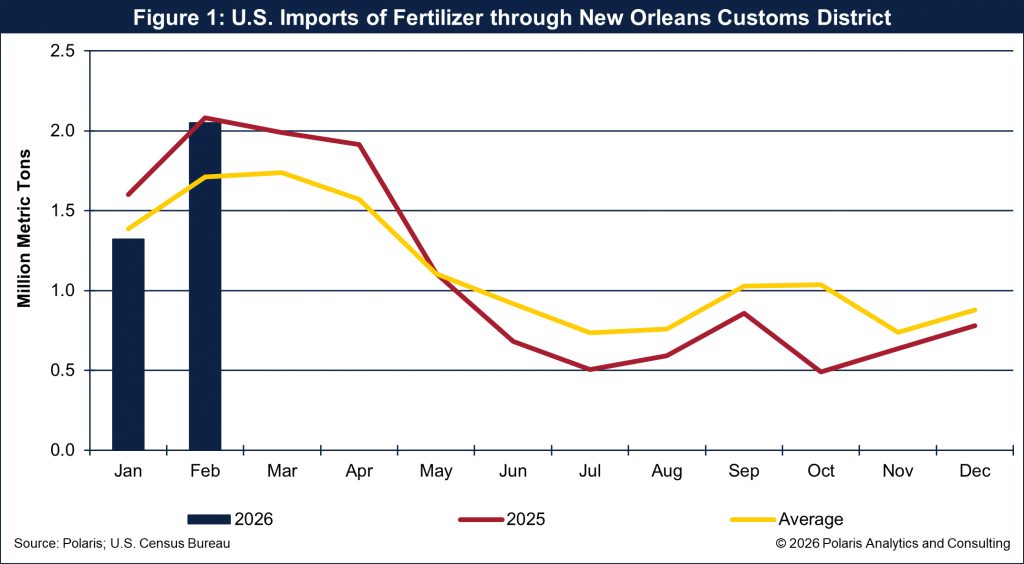
The immediate effects are visible with higher fuel and fertilizer prices. Many U.S. farmers had forward-purchased fertilizer for spring field work, and much of the early surge was already moving by barge before the latest Middle East conflict intensified.
Imports through the New Orleans Customs District in January and February 2026 totaled 3.4 million metric tons: 9% above average. Fertilizer imports typically peak February through April, as shown in Figure 1.
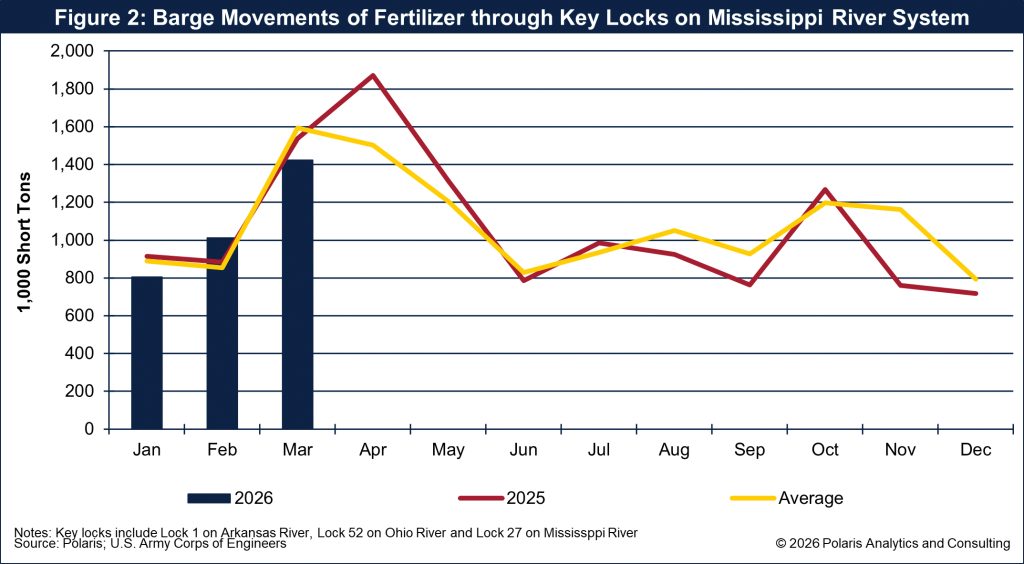
For the first three months of 2026, barge fertilizer movements through key locks on the Mississippi River navigation system have totaled 3.2 million short tons, just 3% below average, as shown in Figure 2.
Brazil and other competitors have been hit harder, but a prolonged disruption at Hormuz could still pressure U.S. farmers’ summer and fall applications.
At the same time, U.S. liquefied natural gas (LNG) exports continue to climb to supplant trapped volumes in the Middle East, with growing volumes to Asia adding pressure to Panama Canal transits. Crude oil exports are also rising, bringing a steady stream of tanker vessels to U.S. export facilities.
These outbound flows compete directly for vessel capacity that might otherwise serve domestic needs.
OPEC+ Fracture
The recent exit of the United Arab Emirates from both OPEC and OPEC+ (effective May 1, 2026) highlights shifting dynamics in global energy markets.
Previously constrained by quotas to roughly 3.3–3.6 million barrels per day, despite having sustainable capacity near 4.8 million barrels, the UAE now plans to ramp up toward a 5 million bpd target by 2027. This move demonstrates confidence in its ability to utilize alternative export routes that can partially bypass the Strait of Hormuz.
It also signals to other members that bilateral flexibility and national interests may outweigh multilateral cartel discipline — aligning with the current administration’s preference for targeted, bilateral energy diplomacy.
Jones Act Waiver
On March 18, 2026, President Donald Trump issued a 60-day Jones Act waiver. On April 24, the administration extended it for another 90 days through mid-August, allowing foreign-flagged vessels to carry oil, refined fuels, fertilizer and related energy products between U.S. ports. The Jones Act does not restrict foreign shipments to or from the U.S., only U.S. point-to-point shipments internally.
Secretary of Agriculture Brooke Rollins and other cabinet officials held a news briefing at USDA headquarters to underscore the importance for farmers facing higher input costs.
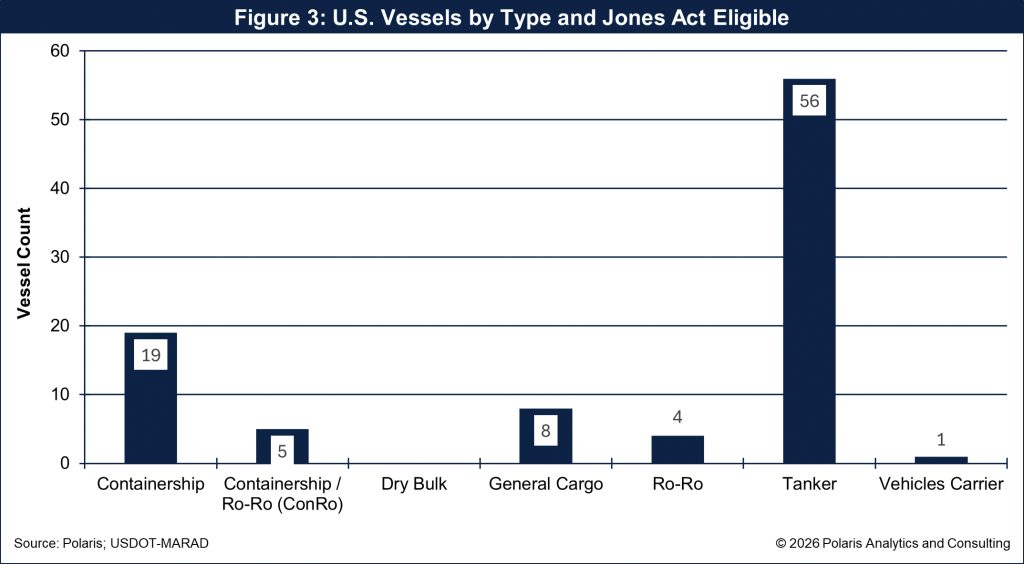
The U.S.-flagged Jones Act oceangoing fleet numbers fewer than 100 vessels, most of them tankers, as shown in Figure 3. That fleet has performed admirably under strain — maintaining critical deliveries to non-contiguous markets and supporting export terminals — but capacity has been tight.
Early Maritime Administration (MarAd) data and independent analyses show the waiver has seen modest utilization, with foreign tankers providing limited additional capacity. Overall, the waiver has produced no measurable impact on nationwide gasoline prices, underscoring both the resilience of the domestic fleet and the constraints of global vessel demand.
The Jones Act waiver has offered some short-term coastal breathing room that ultimately serves inland river systems, while highlighting the narrow margins in U.S. maritime infrastructure.
Waterways Lead Fuel Efficiency
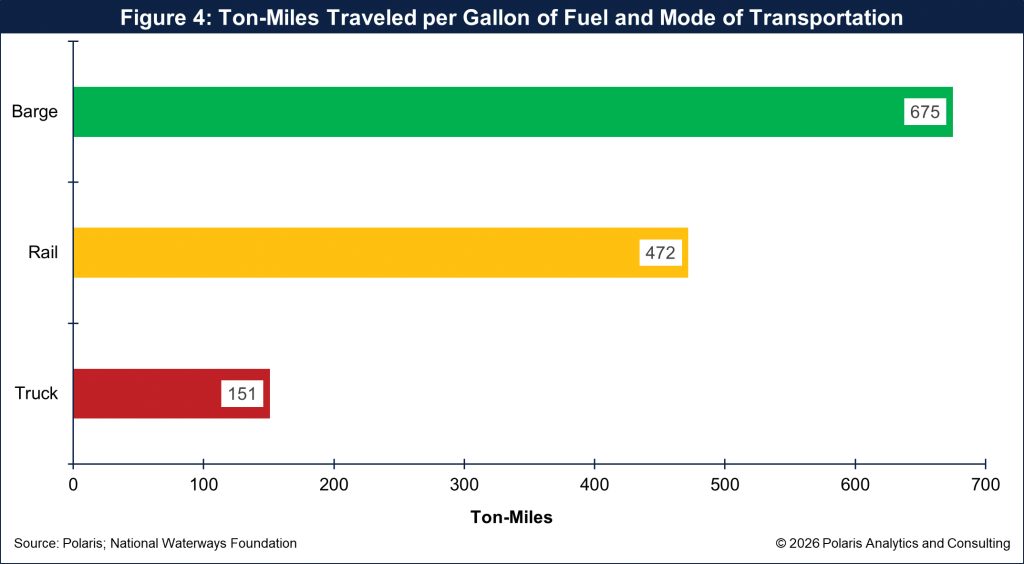
Even with higher fuel costs, the waterways retain a decisive advantage. Barges still deliver the lowest fuel consumption per ton-mile of any mode — hauling commodities 1.4 times farther than rail and 4.4 times farther than truck on a single gallon of fuel, as shown in Figure 4.
High fuel prices may give barges the sniffles, but they give trucking pneumonia.
Panama Canal Bolstered
For every challenge, there is an opportunity.
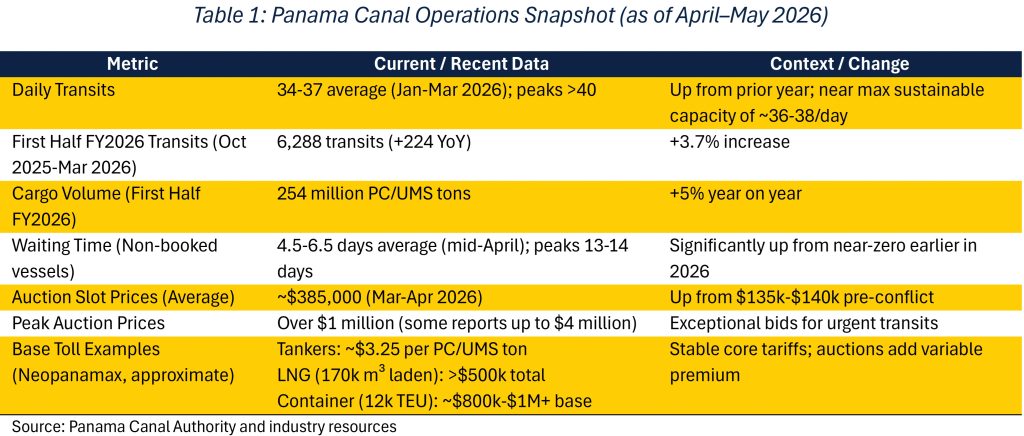
Surging U.S. LNG and energy shipments to Asia, rerouted around Middle East tensions, have boosted traffic through the Panama Canal. Increased transit delays and higher costs (fuel, charter rates and especially auction premiums to secure earlier slots) have strengthened the waterway in the short term.
Recent data illustrate the shift as shown in Table 1.
These dynamics demonstrate how global rerouting can create new traffic patterns even as they strain existing infrastructure — and ultimately feed more cargo opportunities onto U.S. inland rivers. A note of caution: the steady stream of ocean vessels carrying U.S. exports through the Panama Canal will face pressure and higher transit costs that could offset some Gulf gains.
Homeland Difference
Longer term, these disruptions are accelerating reshoring, nearshoring and friendshoring. Retailers such as Lowe’s and others are shifting away from distant supply chains and increasing purchases from U.S. manufacturers — another development that ultimately funnels more cargo onto the inland rivers.
When The Bell Tolls
When the bells toll at the world’s strategic chokepoints, the toll covers a very wide net indeed.
From a framework developed in 2005, any closure or restriction in a major river, strait, channel or canal suddenly requires far more transport capacity to move the same volume of cargo. When that capacity cannot be conjured overnight, freight rates rise sharply.
Someone always pays the freight: downstream consumers and industries absorb higher costs, while upstream producers watch prices collapse as their commodities back up on the dock or in the silo.
If the impediment lasts, new competition springs up elsewhere, and local economies suffer as investment and purchasing dries up.
It is not commodities, products or goods that are being traded as much as freight and transportation. Transportation is what delivers value through the supply chain.
A farmer carrying a mountain of debt in America’s heartland and a hungry family on the other side of the globe are far more connected than most people realize.
In the end, no waterway, no port, and no region stands alone.
So, for whom does the bell toll?
In the geopolitics of maritime chokepoints and the daily reality of the inland waterways, it tolls for all of us.